


Measuring the crowding-out effect and what it takes to bring private capital back to “slow” infrastructure in the UK.
Capital is shifting from basic infrastructure to data centers
Over the past decade, investment money has been moving away from traditional infrastructure, like roads, water pipes, and sewage systems, and toward data centers.
This shift reflects how investors see risk, growth, and uncertainty.
Data centers are the physical buildings that power the internet, cloud computing, and artificial intelligence. Demand for these services has increased significantly in recent years and investors expect it to keep growing. Research shows a strong pipeline of new data-center development across the UK, driven primarily by AI (Oxford Economics – The UK’s data centre boom).
Several factors explain why capital is flowing in this direction:
Demand is growing fast and is easy to see.
AI, cloud services, streaming, and digital businesses all rely on data centers. Industry analysis highlights how quickly these facilities are becoming a core part of the UK economy (TechUK – Foundations for the Future).
Projects are quicker to build and easier to repeat.
Compared with roads or water networks, data centers usually face fewer years of planning uncertainty and can be built using standard designs, making timelines more predictable.
Government signals are supportive.
The UK government has publicly welcomed foreign and domestic investment in data centers as part of its growth and AI strategy, reducing fears of policy resistance (UK Government – Data center investment announcement).
Returns are easier to understand.
Data centers often operate under long-term contracts with large technology firms, which makes future income more visible and reduces uncertainty.
As a result, data centers increasingly look like a safe and scalable investment, especially when compared with slower, more politically sensitive infrastructure.
What this means: Essential infrastructure is being left behind
When capital flows strongly in one direction, it often flows away from something else.
In the UK, roads, water systems and sewage networks are aging and under strain. Investment has not stopped, but it has struggled to keep pace with population growth, climate pressures and maintenance needs.
Official data shows that investment in traditional infrastructure has been uneven over time, while private investment in digital and energy-related assets has accelerated (Office for National Statistics – Infrastructure statistics).
In the water sector, regulators and industry bodies have warned that years of underinvestment have contributed to leakage, pollution incidents and system stress. The latest regulatory review explicitly recognizes the need for a significant increase in spending (Water UK – PR24 investment plans).
At the same time, industry research shows a surge in announced and planned data-center investment since around 2020, including multiple large-scale projects across the UK (Oxford Economics – UK data center investment trends).
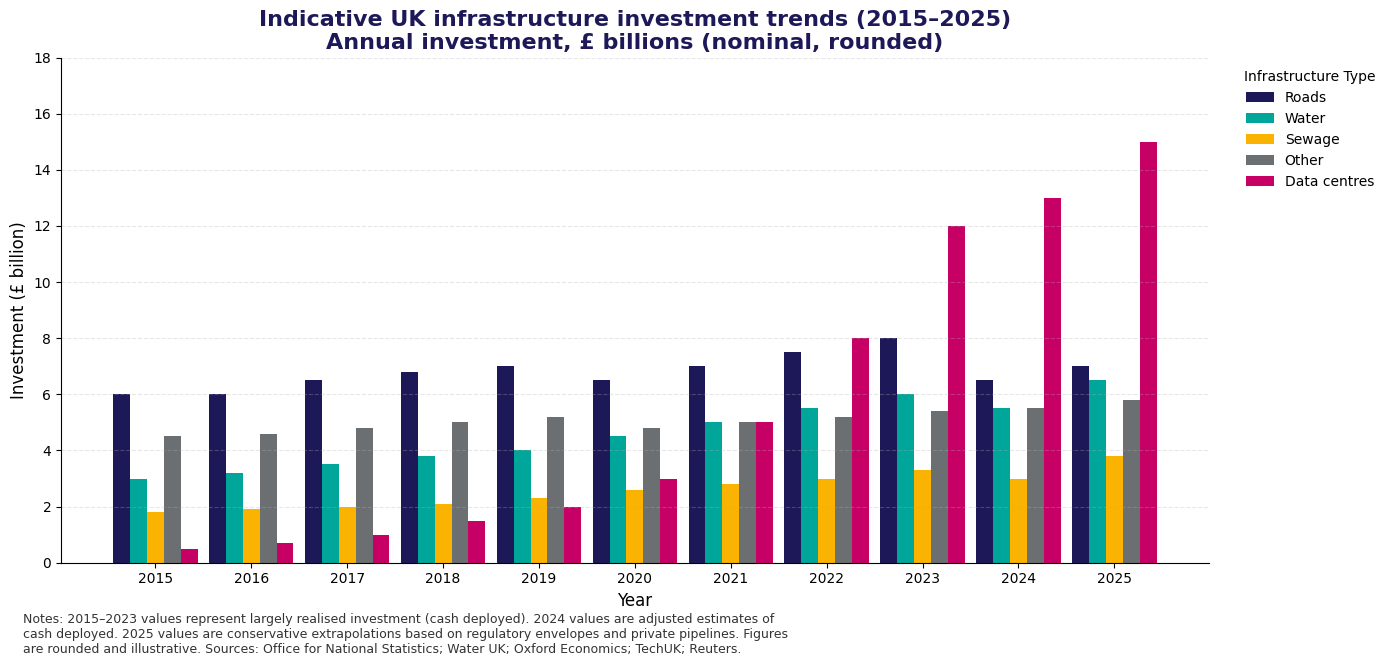
The risk is not just inconvenience. When core infrastructure is under-maintained, problems tend to surface suddenly, through road failures, water shortages, sewage spills, or sharply rising repair costs.
How regulators and policymakers can help redirect investment
Private investors do not avoid roads or water because they are unimportant. They avoid them when the risks feel unclear or unpredictable.
If governments want more long-term capital to flow back into essential infrastructure, the focus should be on reducing uncertainty.
There are several practical steps:
Provide clear and consistent information.
Investors need reliable data on asset condition, long-term plans, and performance expectations. Improving the clarity and consistency of existing public data can significantly improve confidence (Office for National Statistics – Infrastructure data).
Support projects early on.
Many infrastructure projects face the greatest difficulty during planning and approvals. Early-stage public support can make projects far easier to finance later (UK Infrastructure Pipeline).
Keep rules stable and predictable.
Investors can adapt to strict rules, but sudden changes or unclear enforcement increase risk and raise costs.
Share risk where appropriate.
Some risks such as extreme weather or legacy system failures are hard for private investors to manage alone. Carefully designed public support can unlock private investment without weakening public oversight.
These approaches do not reduce accountability, they help align private investment with public needs.
Why balanced infrastructure matters
A functioning economy needs many types of infrastructure at the same time. Data centers are important, but they depend on other systems: electricity networks, water supply, transport links and resilient local services. When investment becomes too concentrated in one area, weaknesses develop elsewhere.
Over time, these imbalances can reduce productivity, raise costs for households, and create environmental and social problems that are expensive to fix later.
Vallorii helps decision-makers see these risks early.
By using data and independent analysis, Vallorii supports governments, regulators and investors in:
- Understanding where infrastructure investment is falling behind
- Comparing risks across different types of infrastructure
- Designing policies that attract long-term, responsible investment
- Supporting a more balanced and resilient infrastructure system
The goal is not to slow investment in data centers. It is to ensure that essential infrastructure, the systems people rely on every day, keeps pace with economic and technological change.
References
- Oxford Economics: The UK’s data centre boom: Growth trends, drivers and the rising power challenge
- TechUK: Foundations for the Future: How data centres can supercharge UK economic growth
- UK Government: Tech Secretary welcomes foreign investment in UK data centres
- Office for National Statistics (ONS) — Experimental infrastructure statistics
- Water UK: PR24 and future water investment
- UK Government: UK Infrastructure Pipeline
- Investment trends chart: sources as printed on the chart: Office for National Statistics; Water UK; Oxford Economics; TechUK; Reuters.